
🔧 Managing a compactor fleet? Discover our dedicated IoT telemanagement solution: real-time monitoring, email alerts, prediction of the next full load.
Overview of industrial waste telemanagement
Industrial waste telemanagement transforms how production sites manage their waste treatment equipment. No more systematic control rounds, ignored overflow alerts or bins that overflow between visits. With a remote management solution, every connected compactor, bin or container feeds data in real time to a dashboard accessible from any web browser.
For industrial sites, this change delivers measurable operational gains: fewer unnecessary interventions, optimized collection rounds and stronger compliance with waste traceability obligations. This guide explains how an industrial waste telemanagement architecture works in practice, what equipment is needed and how to choose a solution suited to your fleet.
What is industrial waste telemanagement?
Industrial waste telemanagement refers to the set of technologies that allow remote monitoring, control and optimization of waste management equipment on industrial sites. It relies on three pillars:
- Data collection: fill level, number of compacting cycles, temperature, vibrations, opening/closing of bins.
- Transmission: data is sent via cellular (4G/5G) or LoRa to a cloud platform.
- Exploitation: a dashboard displays information in real time and triggers automatic alerts.
In practice, a connected box is installed on each piece of equipment (compactor, bin, container). It collects data from integrated sensors and sends it periodically. The site manager then checks the dashboard to know exactly which piece of equipment needs attention — without traveling to the site.
Why telemanagement is becoming essential in 2026
Several factors converge to accelerate adoption across industry:
- Rising collection costs: carriers charge increasingly for out-of-plan removals.
- Regulatory obligations: precise waste-flow tracking requires documentary traceability that paper can no longer cover.
- CSR pressure: boards demand consolidated reporting on waste volumes generated per site.
- Maintenance staff shortage: teams are reduced and must focus on high-value interventions.
How do connected bin control systems work?
A industrial waste management solution relies on a layered architecture. Understanding each layer helps evaluate market offerings and identify the one that fits your environment.
The remote monitoring box on the equipment
The heart of the system is the IoT box mounted on the equipment. It performs several functions:
- Fill-level measurement: one or more ultrasonic sensors measure the distance between the sensor and the waste surface. The shorter the distance, the higher the level.
- Compaction-cycle counting: each compression cycle is recorded. A high number of cycles without emptying can indicate a mechanical problem.
- Data transmission: information is sent over 4G/LTE cellular network every 5 to 30 minutes depending on configuration.
- Local alerts: a buzzer or LED visually signals a critical threshold reached on the equipment itself.
The cloud platform and dashboard
Data transmitted by the boxes arrives on a secure cloud server. A web interface — the waste management dashboard — enables visualization of:
- The fill level of each bin or compactor in real time.
- Level history over 30, 90 or 365 days.
- The number of compaction cycles completed.
- The list of active alerts (high level, full level, technical failure).
- Recommended collection rounds optimized according to real levels.
Notifications and alerts
When a defined threshold is exceeded, the system sends an automatic notification. Depending on configuration, it can be an email, SMS or push notification. Critical alerts (imminent full load) are transmitted with priority to allow quick intervention before overflow.
Which box should you choose for your waste management equipment?
The choice of telemanagement box for compactors and bins determines the reliability of the entire system. Here are the technical criteria to evaluate before signing a contract.
Integrated sensor types
Not all boxes measure the same quantities. The most common sensors are:
- Ultrasonic level sensor: the standard for measuring fill level. Accurate to ±2 cm under normal conditions.
- Vibration sensor: detects compaction cycles and signals abnormal operation (excessive or insufficient vibrations).
- Temperature sensor: useful for equipment handling thermally risky waste (certain production residues).
- Door contact: signals opening of the emptying flap, allowing correlation of actual emptying with low-level alerts.
Network connectivity
Almost all modern boxes use 4G/LTE cellular network for transmission. This offers several advantages:
- Quasi-universal network coverage on French territory.
- No need for on-site Wi-Fi infrastructure.
- Moderate power consumption, compatible with battery or solar supply for isolated sites.
Some boxes also offer LoRa connectivity for sites that already have an internal LoRaWAN network, with reduced transmission costs. The choice depends on existing infrastructure and the number of devices to connect.
Sealing and mechanical robustness
Industrial waste management equipment operates in demanding environments: dust, humidity, projections, temperature variations. The box must meet a minimum IP65 protection rating to ensure a service life exceeding five years without maintenance.
Energy autonomy
For sites where electrical supply is not available near each bin, box autonomy is a decisive factor. The most economical 4G boxes last 3 to 5 years on internal battery with transmission every 15 minutes. Beyond that, a sector-powered or solar-powered box will be more appropriate.
Which waste types can be supervised with telemanagement?
Industrial waste telemanagement is not limited to standard bins. It adapts to a wide variety of equipment and waste streams.
Industrial waste compactors
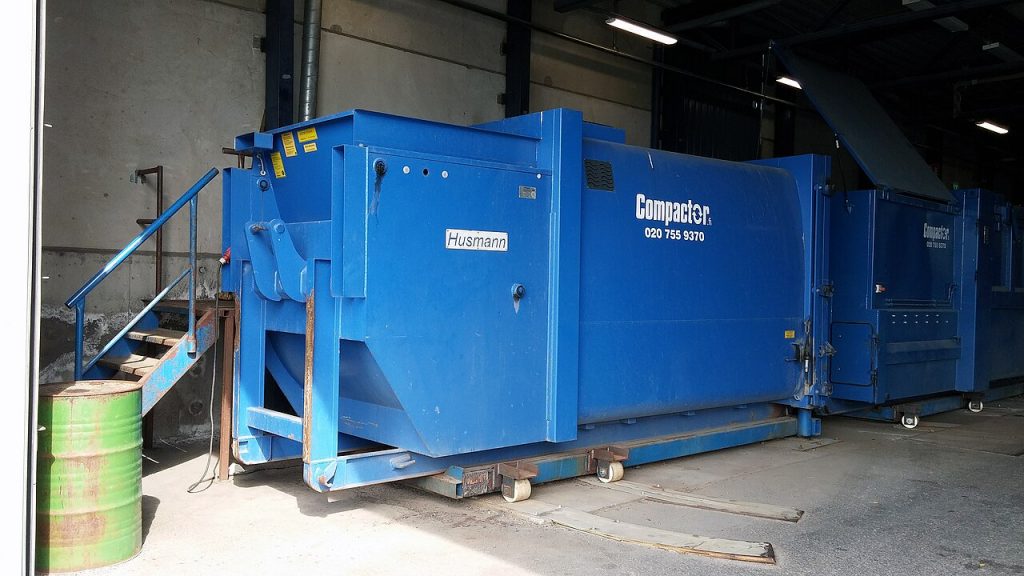
Compactors are the most commonly remotely supervised equipment. Measuring fill level and number of cycles allows anticipating emptying and detecting operating anomalies. On multi-compactor sites, the dashboard offers a consolidated view that greatly simplifies intervention planning.
Industrial waste bins
Open or closed bins, of standard volume (5 to 30 m³), are equipped with ultrasonic sensors fixed under the cover. The box transmits the level and alerts when the bin reaches 75% or 90% of its capacity. This allows planning removals only when needed, instead of following a fixed schedule that never exactly matches reality.
Buried or semi-buried containers
Buried containers (hollows) present a particular challenge: the box must operate on battery for several years without access to electricity. Specialized solutions use low-consumption sensors and very occasional transmissions (once per day) to maximize autonomy. The service level is adapted accordingly, but the savings on collection rounds remain significant.
Specific waste: cardboard, metals, plastics
Each waste type has its own stacking and compaction characteristics. A well-configured industrial waste management system allows defining custom thresholds according to waste density. A cardboard compactor, for example, reaches a high fill level faster than a metal compactor — sensors must be parameterized accordingly to avoid false alerts.
How much does an industrial waste telemanagement solution cost?
The budget question is central to any reflection on industrial waste telemanagement. Like any IoT project, total cost combines an initial investment (equipment) and recurring fees (subscription).
Supervision box purchase cost
The purchase price of a telemanagement box for bins and compactors varies by features:
- Level measurement only models: €250 to €400 excl. VAT per box.
- Level + cycle counting + vibration models: €400 to €650 excl. VAT.
- Reinforced models for extreme environments: €700 to €1,200 excl. VAT.
Some suppliers also offer rental with a 3 to 5 year commitment, which spreads the initial cost and includes software maintenance. Pure rental is around €15 to €30 excl. VAT per month per box.
Monthly subscription fees
The subscription covers 4G connectivity, cloud hosting and dashboard access. It depends on the number of devices and included services:
- Essential plan (real-time data + alerts): €10 to €20 excl. VAT/month per box.
- Advanced plan (long history, reporting, API): €20 to €35 excl. VAT/month per box.
- Multi-site pack with consolidated dashboard: progressive pricing from 50 boxes.
Installation cost
Installation is usually performed by the provider or an integration partner. It includes mounting the box on the equipment, sensor parameterization and dashboard commissioning. Cost varies with accessibility and number of units:
- Standard installation (mount and configure): €80 to €150 excl. VAT per box.
- Complex installation (hard-to-access equipment, specific wiring): on quote.
For an industrial site with 10 compactors, initial investment (equipment + installation) typically falls between €4,000 and €10,000 excl. VAT, plus a monthly subscription of about €150 to €300 excl. VAT.
Return on investment: industrial waste telemanagement in practice
Field feedback shows that equipment management telemanagement generates measurable savings from the first year. Three savings areas are consistently cited:
Reduction of unnecessary removals
Without real-time data, carriers are called according to a fixed schedule, regardless of actual bin levels. With connected management, removal is triggered only when the defined threshold is reached. Equipped sites reduce annual emptying by an average of 30 to 40% for the same waste volume treated.
Elimination of on-site control interventions
Maintenance staff traditionally spend time visually checking equipment status. With automatic alerts, these control rounds are reduced or eliminated. The recovered time can be allocated to preventive maintenance operations with higher added value.
Collection planning optimization
Historical fill-level data helps identify input peaks and adapt planning. Over time, the volume of waste actually collected matches the volume actually generated — without surplus or deficit. This optimization benefits both the industrial operator (lower costs) and the carrier (better planning).
Industrial waste telemanagement: pitfalls to avoid before signing
Despite demonstrated benefits, some connected bin telemanagement projects fail to deliver expected results. Here are the most frequent mistakes to anticipate.
Choosing a box without local support
Purely foreign solutions or those without a French support structure pose problems in case of failure. A box that stops transmitting for several days may go unnoticed if no one monitors the dashboard. Verify that the provider has responsive, French-speaking technical support.
Neglecting site network coverage
Before equipping your bins, conduct a 4G coverage audit across the entire site. Some industrial sites, especially in rural areas or inside metal buildings, have shadow zones where transmission is impossible or intermittent.
Underestimating parameterization work
A poorly parameterized box generates inappropriate alerts: thresholds too low = excessive alerts that fatigue teams; thresholds too high = bins overflowing between alerts. Optimal parameterization requires adjustment over 2 to 4 weeks, based on real waste input data.
Choosing a non-scalable solution
Your bin and compactor fleet will likely evolve (expansion, new equipment, new site). Choose a solution that can accept new boxes without architecture changes and without prohibitive migration costs.
Conclusion
Industrial waste telemanagement is no longer an experimental project reserved for large industries. It is becoming a standard accessible to medium-sized sites, with return on investment reached in 12 to 24 months depending on the number of supervised devices.
The principle is simple: equip each bin and compactor with a connected box that measures fill level, transmits data in real time and triggers automatic alerts. The site manager then has complete visibility from the dashboard, wherever they are.
To discover the connected management solution for compactors and bins developed by IOTINNOV, visit the dedicated page:
IOTINNOV Compactor Supervision Box
Would you like to evaluate the savings potential on your site? IOTINNOV offers a free 30-minute diagnostic to analyze your equipment fleet and identify accessible gains with connected telemanagement.
Related article: How industrial compactor telemanagement works — detailed explanations of technical architecture and communication protocols.
Related article: Compactor fill level: how to measure remotely — sensor technologies and parameterization best practices.
The logic is identical for an individual connected compactor or an entire fleet.
>A similar need on your fleet?
Let’s talk for 10 minutes — no commitment
Let’s talk about your need →Read also
- Industrial waste compactors: complete guide to types, selection criteria and m
- How much does a telemanagement system for compactors cost in 2026?
- Compactor Telemanagement: The 10 Must-Have Features for 2026
- Your Compactor Broke Down This Weekend? What If You Could Have Prevented It
- How to connect a compactor in 4G: complete guide
- How compactor telemanagement works: complete guide
- Compactor telemanagement and connected compactors: why switch to IoT-based mon
Un besoin similaire sur votre parc ?
Échangeons 10 minutes — sans engagement
Parlons de votre besoin →