
If you operate a fleet of waste compactors and containers spread across several sites, you know the pattern. Collections are scheduled weeks ahead on a fixed calendar that has nothing to do with how full each unit actually is. Some visits arrive when the compactor is barely one third full: a truck, a driver, a fuel bill and a slot in the route spent for nothing. Others arrive too late, after the chamber has been full for two days, the loading bay smells, and staff start stacking pallets on the ground next to the machine.
The breakdown nobody notices is worse. A compactor that trips on a hydraulic fault on Friday evening sends no signal at all. It stays out of service until the next scheduled visit, often days later, while waste accumulates and the whole site reorganises itself around a machine that is quietly doing nothing.
Connected compactor monitoring removes that blind spot. A compact device wired into the compactor’s existing control cabinet reports fill level, power status, compaction cycles, position and critical events to a web platform in real time, so collection rounds, maintenance and emergency call-outs are driven by data instead of by the calendar.
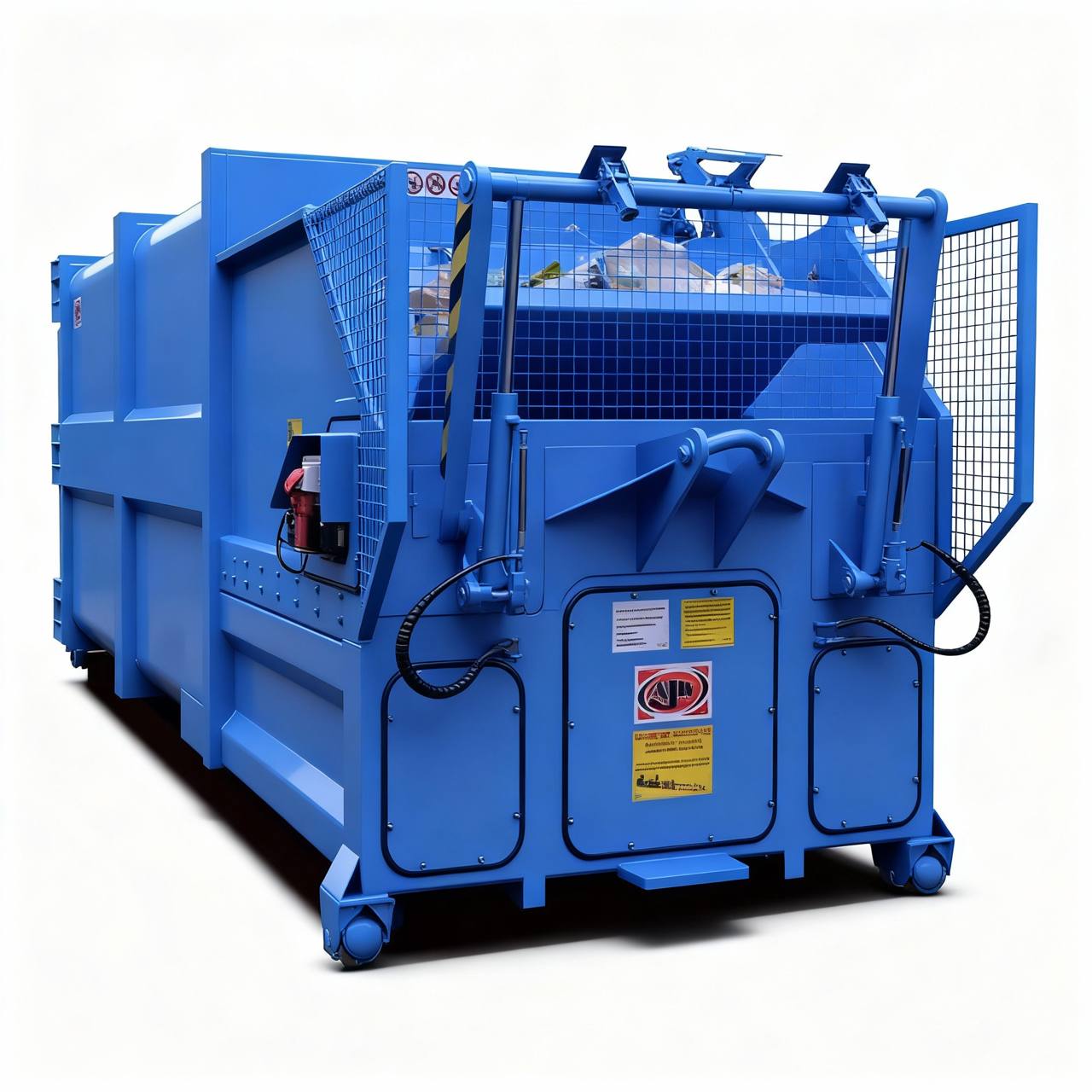
What is waste compactor telemanagement?
Waste compactor telemanagement – also called remote compactor monitoring or compactor telemetry – is a system that lets you supervise, analyse and control one or several waste compactors from a distance, using connected sensors and a software platform. Instead of sending an operator on site to read a fill level or check whether a machine is running, the system captures the electrical signals already present in the compactor’s control cabinet and publishes them to a cloud platform over a cellular network.
The important point is that nothing about the compactor itself changes. Compaction force, the hydraulic system and the container interface stay exactly as they are. Telemanagement is a supervision layer added on top of equipment you already own – not a new generation of machinery that has to be purchased.
What you get in return is a single dashboard listing every unit in the fleet: how full it is, whether it is powered, how many cycles it has run today, where it is, and which events need attention. The same data feeds an alert engine, a maintenance history and a fill-level forecast. Read a broader overview of the topic in our guide to IoT in waste management.
Why traditional compactor management is no longer enough
Organisations that manage compactors and waste containers without telemetry run into three structural problems. None of them is a question of effort or discipline – they are simply the consequence of having no data.
No real-time visibility. Without monitoring, nobody knows whether a compactor is three quarters full or already full. Collection rounds are therefore planned on fixed intervals, which are too early as often as they are too late: unnecessary trips in one period, overflows and odour complaints in the next.
Silent breakdowns. A compactor that fails between two maintenance visits generates no signal whatsoever. It can stay out of service for days or weeks, with waste piling up and no compaction possible. On a retail site or a production plant, that quickly turns into a handling problem, a hygiene problem and, often, an avoidable cost.
Collection rounds planned blind. Without historical fill data, logistics teams cannot anticipate demand. Routes are built on habit rather than on need, which typically means unnecessary mileage, avoidable emissions and premature wear on collection vehicles. Where collection is invoiced per lift or per tonne, the same lack of data also makes it difficult to challenge or justify a bill.
How remote compactor monitoring works
The architecture has three layers. Each one is simple on its own, and the intelligence comes from combining them.
Sensing
The monitoring unit is connected to the digital inputs of the compactor’s control cabinet. Those inputs already carry the machine’s own logic: powered on, three-quarter full, full, emergency stop, low oil level, container present. Instead of adding new sensors to the mechanics, telemanagement listens to signals the compactor already produces and timestamps every state change.
Transmission
Data leaves the unit over a cellular network – 4G LTE-M or NB-IoT depending on coverage – with no site network, no IT project and no gateway to install. Communications use a lightweight publish/subscribe protocol over an encrypted connection, which keeps latency low and data consumption minimal.
Platform
The cloud platform consolidates every machine in the fleet. Operators see fill levels, sensor states, alert history and next-full forecasts from a browser or a mobile device. Alerts are pushed out by email as soon as a threshold is crossed, and an open API allows the same data to flow into an ERP, a CMMS, a WMS or a customer portal. Nothing needs to be hosted on site, and no infrastructure has to be deployed in the building.
What you can measure in real time
- Fill level. The three-quarter-full signal tells you when the ideal window for the next collection opens; the full signal warns you of an imminent overflow. Both thresholds are configurable per machine.
- Power supply. The unit is powered from the compactor’s 24V AC/DC cabinet, so a mains failure, a tripped breaker or a shutdown immediately becomes a visible event instead of an unexplained silence.
- Compaction cycles. Every cycle is recorded. Cycle counts per day, per week and per month reveal the real pace of waste generation on each site and sharpen the fill forecasts.
- Position. Built-in positioning shows each compactor on a map – useful for fleets spread over a territory, and essential when equipment can be moved between sites.
- Critical events. Emergency stop triggered, low oil level, container or skip missing: each event raises a timestamped alert with no human intervention.
- Predicted next full. The platform analyses the cycle history of each machine to estimate when it will next reach capacity. The forecast is recalculated after every cycle, so it gets more accurate the longer the equipment is monitored.
In practice, most fleets only need two or three of these signals to transform the way they operate. Fill level plus power supply plus cycles already covers the vast majority of day-to-day decisions. Our article on the ten must-have features of compactor telemanagement goes deeper into how each one is used.
Connectivity and protocols
4G LTE-M and NB-IoT. The monitoring unit carries a multi-operator SIM that roams automatically between available networks. If signal quality drops on one network, the device switches to another without any action on your side. For underground car parks, basement technical rooms and steel-framed buildings, NB-IoT is preferred: it is a low-power wide-area technology designed for deep indoor penetration and small data volumes, which is exactly the profile of a compactor.
MQTT over TLS. Data is transmitted using MQTT, a light publish/subscribe protocol built for constrained devices and low-bandwidth links. It keeps exchanges short, latency under a hundred milliseconds in normal conditions, and lets the platform handle thousands of units without heavy infrastructure.
Autonomy. The unit draws its power from the compactor’s existing 24V AC/DC cabinet, so there is no separate power supply to install. An internal backup battery keeps alerts flowing for several hours during a mains outage – which is precisely when you most need to know that a machine has lost power.
Retrofit without rewiring. Installation is a connection to existing digital inputs inside the cabinet. No mechanical or hydraulic modification, no new cable runs across the site, typically around fifteen minutes per machine. Wi-Fi and Bluetooth are available for local configuration and on-site diagnostics, and firmware updates are delivered over the air, so new features and security patches do not require a visit.
Traditional compactor vs connected compactor
| Criteria | Traditional compactor | Connected compactor |
|---|---|---|
| Fill level | Checked manually, on site | Visible in real time on a dashboard |
| Collection trigger | Fixed calendar interval | Actual fill level and forecast |
| Breakdown detection | Discovered at the next visit | Immediate email alert with timestamp |
| Overflow prevention | Reactive, after the fact | Prevented through threshold alerts |
| Data history | None | Full history of cycles, events and levels |
| Maintenance | Scheduled blind, or reactive | Planned on real usage and cycle counts |
| Location | Known from records only | GPS position on a map |
| Software updates | On-site intervention | Over the air, remotely |
| Reporting and billing | Manual counts, disputed invoices | Documented, timestamps available |
Which sectors use connected compactor monitoring
- Retail and supermarkets. Cardboard and pallet compactors behind the loading bay, where the main risk is an overflow during opening hours – when the waste cannot easily be moved and every customer can see it.
- Food processing. Compactors handling organic and packaging waste, where a full machine means hygiene exposure as much as a logistics problem.
- Logistics and distribution. Multi-site fleets where nobody has time to walk the yard, and where a silent compactor slows down dock operations within hours.
- Manufacturing and industry. Plants that need a documented view of waste volumes for sorting reports and environmental reporting, without mobilising internal teams.
- Local authorities and municipal services. Markets, stations and public facilities – dispersed sites where every verification trip has a real cost.
- Commercial property and facilities management. Shared service yards where several tenants use the same machine and the site manager needs evidence of who fills it and when.
Waste collection and cleaning contractors are a further obvious fit, since remote supervision both optimises their routes and gives them a documented record of service for their own customers. Our article on smart waste management covers that operational angle in detail.
Return on investment: where the gain really comes from
The return on a compactor monitoring project comes from several distinct sources, and they are worth evaluating separately before building a business case. Bundling them into a single estimate is the fastest way to end up with a number nobody believes.
- Fewer unnecessary collections. Every lift triggered by the calendar rather than by an actual fill level is avoidable spend. On a closely monitored fleet, operators typically find that a significant share of visits was made while the machine still had ample capacity – historically the largest single source of savings.
- Overflows that never happen. A full alert that arrives hours in advance is usually enough to insert the collection into a route that was going to pass nearby anyway. The cost avoided is not only the emergency lift, but the clean-up, the odour complaint and the staff time spent handling waste on the floor.
- Fewer emergency call-outs. A power failure detected in minutes costs a phone call. The same failure discovered three days later often costs an out-of-hours intervention, a lost production area and a rush collection at premium rates.
- Better maintenance planning. Cycle counts and event history turn maintenance from a fixed calendar into a usage-based decision. An abnormally high number of cycles, or a rise in emergency stops, is visible long before the machine fails completely.
- Objective reporting. For contractors who invoice per lift or per tonne, a timestamped fill history changes the relationship with the end customer: disputes tend to disappear once the figures are on the table.
To size your own case, three inputs are enough: the number of sites, the number of collections per month and per site, and the average cost of a lift. Apply to that the proportion of lifts that prove unnecessary once the platform shows real fill levels – this is often visible within the first month of measurement. The result is an order of magnitude for the annual gain, which can then be compared against the cost of the equipment and the subscription. A related example of the same logic applied to routing is set out in our article on optimising waste collection routes with IoT.
Retrofitting and the 2G/3G network shutdown
A large number of first-generation telemetry units installed years ago communicate over 2G or 3G. Mobile networks across Europe have been progressively switching those technologies off, so a 2G or 3G device still in service today is running on a standard at the end of its life, with no guarantee of continuity. The practical consequence is well known to fleet managers: equipment that has been silent for weeks, discovered only when a container overflows.
Migrating does not mean replacing an entire fleet at once. The sensible order of priority is straightforward.
- Start with an inventory. Identify which units are still on a legacy network. Silence in the platform is already a signal: a healthy device reports regularly, a dying one stops.
- Replace on critical sites first. The machines whose failure costs the most – the ones serving a busy loading bay or a production line – are the ones to convert before anything else.
- Consolidate into one platform. During the transition, an open platform can host both old and new units, so you keep a single view of the fleet while it is being renewed.
- Use silence detection as a safety net. A correctly configured monitoring system raises an alert when a device stops reporting, which is exactly what catches the equipment you did not know was already offline. This is the same principle described in our page on avoiding the cost of an undetected full compactor.
Retrofitting is not limited to the migration case. Any existing compactor with a 24V AC/DC control cabinet can be equipped, whatever its brand, model or year of manufacture. That is what makes telemanagement a gradual modernisation programme rather than a fleet replacement.
Data security and privacy
A connected fleet carries operational data: fill levels, position, events, power status. Four principles structure how that data is handled.
- Encrypted communications between every device and the platform, carried over TLS, with mutual authentication of equipment so that only legitimate units can publish data.
- Operational data, not personal data. The system monitors machines, not people. No individual is tracked, and no personal information is collected as part of normal operation.
- Hosting and support in Europe. Data is stored on secure servers in Europe, and access is reserved for the operator of the fleet.
- Maintained over the air. Firmware updates are deployed remotely, so security fixes do not wait for a site visit, and the fleet stays on a current, supported software version.
The underlying rule is simple: the data belongs to the operator of the fleet. It is available on the dashboard, exportable through the API, and never shared with third parties.
Frequently asked questions about compactor IoT monitoring
Does the monitoring device work with any compactor, whatever the brand?
Yes. The unit connects to the digital inputs of the compactor’s existing control cabinet, powered from 24V AC or DC, whatever the brand or model installed. No mechanical or hydraulic modification is required, and no specific wiring harness has to be ordered.
What happens if the compactor is in a basement with no 4G signal?
The device uses NB-IoT, a low-power wide-area technology with far better penetration than standard 4G in basements, underground car parks and enclosed technical rooms. Where coverage is still marginal, an external antenna can be fitted to improve reception.
How long does installation take?
Typically around fifteen minutes per compactor. Network connection is automatic: the unit appears on the platform as soon as it is powered up, so there is no complex configuration step on site.
Can we integrate the data into our own systems?
Yes. An open API exposes fill levels, status and alerts so they can be pushed into an ERP, a CMMS, a WMS or any third-party application. API documentation is available on request.
How are alerts delivered?
By email, in real time, as soon as an event occurs: three-quarter full, full, emergency stop, low oil level, mains failure. SMS notifications are available as an option.
Do we have to replace our existing compactors to get started?
No. Telemanagement is retrofitted to the equipment you already have. Older machines remain fully compatible as long as they have a 24V control cabinet, and the same platform can host units of different brands and generations side by side during a gradual rollout.
See your compactor fleet on a live dashboard
The clearest way to judge a compactor monitoring project is to look at your own fleet through it. Our team can arrange a personalised walkthrough, remote or on site, showing which machines are full, which have gone silent, and what your current collection round would look like if it were planned from real fill levels instead of from a calendar. Ten minutes is usually enough to see whether the numbers work for your sites.