
Every year, thousands of vehicles are stolen and moved out of the country within hours. Once the border is crossed — by road, by ferry or in a container — the chances of recovery collapse. Everything is decided in the first few hours, and that is precisely where most fleets lose the game: for lack of real-time information.
Why a stolen vehicle disappears so quickly
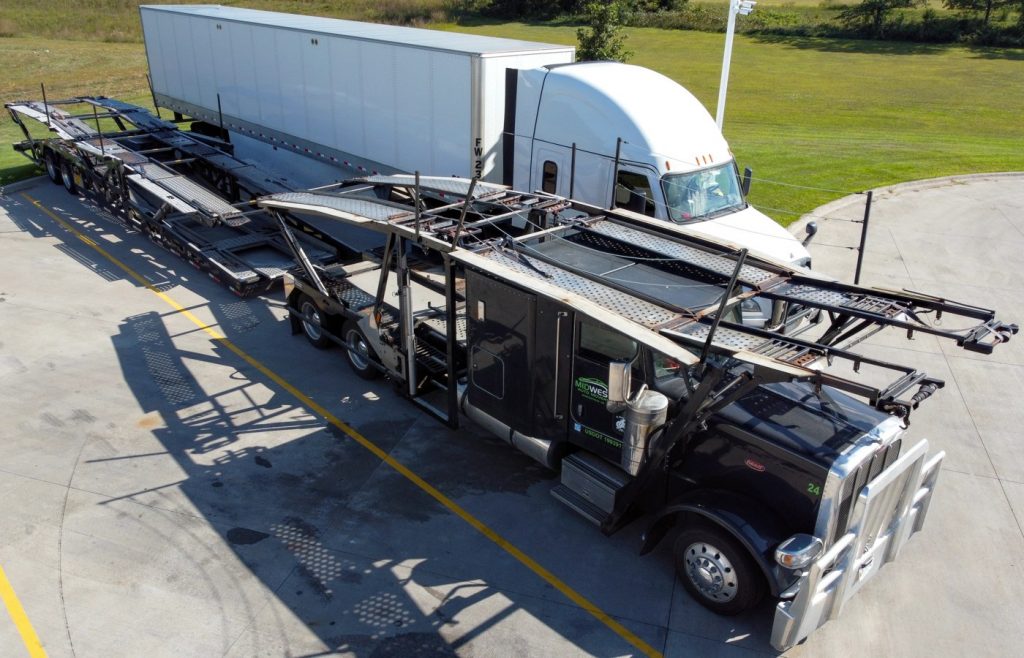
Vehicle theft for export is not an isolated act: it is an organised channel. The vehicle is spotted, stolen, then moved quickly to a collection point. From there it joins a car transporter, a roll-on/roll-off vessel or a container bound for countries outside the European Union, where the options for recourse narrow sharply. Between the moment the vehicle is moved without authorisation and the moment it leaves the national territory, less than twenty-four hours often pass.
For a fleet manager, the problem is not a lack of security equipment. It is the lack of continuous visibility. A fleet of utility vehicles, trucks or rental cars represents dozens of mobile points spread across several sites. Without data reported in real time, every vehicle remains a blind spot until someone notices it has disappeared.
The true cost of a theft does not stop at the vehicle
The first instinct is to compare the value of the stolen vehicle with its replacement cost. The reality is heavier. An immobilised utility vehicle means a round that does not go out, a site that falls behind schedule, a rental that can no longer be honoured. For a rental company, the loss of revenue is added to the loss itself; for a business, the disruption is paid for in working hours and penalties.
Then comes the impact on insurance, the excess, the administrative burden of the claim, and above all the replacement lead time. Finding an equivalent vehicle at short notice is rarely immediate, and the fleet runs below capacity for weeks. Finally, there is the invisible cost: that of an organisation that discovers the problem too late and, at that point, has no room for manoeuvre left.
The decisive window: the first few hours
Reporting the theft and going through the insurance process are essential, but they come after the fact. Yet a vehicle intended for export does not stay put: it moves fast, it changes hands, and it crosses a border. Every hour of delay reduces the options for intervention — and, in the case of a departure by sea, leaving the territory quickly becomes permanent.
So it is less a question of security hardware than of detection time. Between the start of the theft and the moment it is noticed, that interval must be cut to a minimum. That is exactly what a supervision system delivers when it reports the information as the event happens, rather than the next morning.
What connected supervision brings to a fleet
Modern supervision platforms do more than display a position on a map. They monitor events and trigger alerts. In practice, four capabilities change the game when facing a theft for export.
Real-time location. Every vehicle remains identifiable at all times, including when it travels on an unplanned route. The manager knows where it is, without waiting to open a procedure.
Geofence exit alert. This is the most effective lever in this scenario. An authorised zone is defined for each vehicle or each site. As soon as the vehicle leaves it — at night, on a non-working day, or outside any planned mission — an alert is sent immediately. The signal arrives while the vehicle is still on national territory, so during the only period when intervention is still possible.
Out-of-hours movement alert. A vehicle that moves when it should be parked is a strong signal. This detection works even without a zone exit, particularly for closed parking areas or logistics sites.
Tampering or jamming detection. An attempt to neutralise the tracking device results in an abnormal loss of signal. Reported as an alert in its own right, it becomes security information rather than a mere technical incident to correct later.
Some platforms go further and allow, within a strictly controlled framework configured with the operator, remote immobilisation of the vehicle. Used proportionately and in compliance with the legal framework, this capability is the last safety net: it makes it impossible to leave the territory before the border is crossed, where recovery becomes a matter of hours.
An adaptable approach, not an off-the-shelf product
At IOTINNOV, we do not claim to offer a universal, ready-to-use anti-theft solution. Our telemanagement platform, proven on industrial compactors, detects state changes in real time and triggers automatic alerts. That same logic — event-driven, reliable, without heavy infrastructure — can be adapted to monitoring a fleet of vehicles or mobile machinery.
This means the solution is not simply about installing standard hardware. It is built from your real constraints: which vehicles are critical, which zones must be monitored, which schedules are normal, who should receive the alert and in what form. The goal is to surface the right information at the right time, not to add another technical layer.
This approach continues our work on protecting mobile fleets: the same event-driven detection logic, applied to different equipment depending on the need.
What this changes in practice
For a fleet manager, the point is not to watch continuously, but to be alerted at the right moment. A geofence exit alert received a few minutes after a vehicle moves still leaves time to act: notify law enforcement with a precise position, inform the insurer, alert the teams. The information becomes actionable because it arrives during the decisive window.
The second effect is preventive. A fleet whose vehicles are tracked and whose zone exits systematically trigger an alert becomes a less obvious target. Deterrence no longer rests solely on fencing or patrols, but on the fact that unauthorised movement will be detected immediately.
Finally, the accumulated data becomes useful day to day: actual routes, downtime, out-of-hours usage, underused vehicles. Security monitoring and fleet management then rely on the same information, with no double entry and no extra tool.
The first step remains simple: a ten-minute conversation to identify the most sensitive vehicles and zones in your fleet, and to assess what can realistically be put in place. There is no commitment and no large-scale rollout — just an honest assessment of what is useful for your situation.
À lire aussi
- Edge Computing for Industrial IoT: Architecture, Protocols, and Deployment Str
- Professional Embedded Debugging: JTAG, OpenOCD and GDB — The Complete Workflow
- Generative AI for Industry: Concrete Use Cases, RAG Architecture and Return on
Un besoin similaire sur votre parc ?
Échangeons 10 minutes — sans engagement
Parlons de votre besoin →