
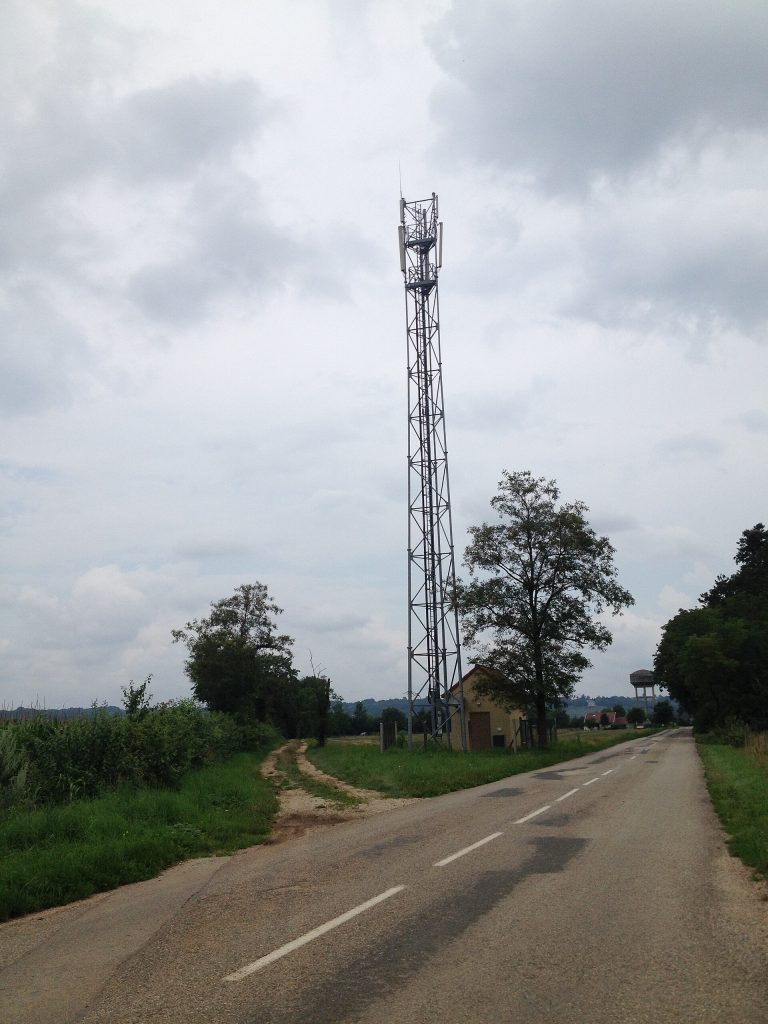
Your compactors report their fill level, flag anomalies, and trigger collection rounds at the right time. This supervision relies on a box that communicates over the mobile network.
This network is disappearing. Operators are shutting down 2G, then 3G. A box that relies only on these technologies will stop transmitting permanently — without warning, without failure, without any possibility of return.
What the operators announced
ARCEP, the French electronic communications regulator, publishes the shutdown schedule for 2G and 3G networks. Below are the deadlines announced by the operators for metropolitan France.
| Operator | 2G Shutdown | 3G Shutdown |
|---|---|---|
| Orange | Rollout across the entire country, late September to late December 2026 | 2028 |
| SFR | 15 November 2026 | End of 2028 |
| Bouygues Telecom | Rollout from December 1 to 15, 2026 | End of 2029 |
| Free Mobile | No own 2G network (schedule identical to Orange’s) | Not yet announced |
The schedule may evolve according to operator announcements. Orange has already rolled out in stages throughout 2026, notably in Bayonne, Anglet, and Biarritz in March, then in Pyrénées-Atlantiques, Landes, and part of the Southwest in May and June.
The situation is straightforward: 2G disappears by the end of 2026, and 3G follows between 2028 and 2029.
Why this shutdown is permanent
This is not a temporary incident that would be fixed in a few weeks. The shutdown of these technologies is an operator decision, driven by several fundamental reasons.
- The manufacturers who build and maintain 2G and 3G equipment are abandoning these technologies: parts and support disappear with them.
- The freed-up frequencies are reassigned to 4G and 5G, improving service quality on those networks.
- 4G and 5G offer enhanced security: advanced encryption, robust authentication, and an architecture designed to withstand current threats.
- 2G and 3G networks consume more power, all else being equal.
No operator will reverse course. A box that relies only on 2G or 3G will therefore never be reachable again.
What this means in practice for a compactor fleet
This is what is often overlooked when the shutdown occurs: the compactor itself continues to operate. It is the supervision that stops.
What you lose overnight, without prior warning:
- the fill level of each compactor, available remotely;
- alerts that trigger intervention: compactor full, emergency stop, power loss, malfunction;
- the history of cycles and events, used to objectify discussions with service providers;
- route optimization, avoiding sending a truck for nothing.
In practice, you are back to operating blind: full compactors that are not collected, trucks sent to already-empty sites, and incidents discovered only at the next visit. All without anyone warning you that the supervision is no longer reporting anything.
4G LTE and low-power technologies
The transition is already in place, and ARCEP confirms it: more than 99.8% of 2G and 3G emission sites are already equipped with 4G, and 4G covers more than 99.9% of the metropolitan population.
For connected objects, two low-power technologies rely on the same mobile infrastructure: NB-IoT and LTE-M. They were designed precisely for this scenario: reduced consumption, better penetration into buildings and basements, and a lifespan designed for equipment that stays in place for years.
- Coverage at least equivalent to what you have today, including areas where 2G was the only available signal.
- Longevity: 4G is the technology of choice for the coming years, and its shutdown is not on the agenda.
- Enhanced security: encryption and authentication at a level far beyond 2G.
- Controlled consumption: important for equipment powered at 24 V and sometimes on battery.
Our compactor telemanagement solution
We design and operate a telemanagement platform for compactors — single-block units as well as fixed stations — and the box we install communicates in 4G LTE.
In practice, nothing changes in your operation: you retain the fill level of each compactor, real-time alerts on state changes, cycle history, and collection rounds built on actual fill levels rather than a fixed schedule.
The change is at the box level, not the platform. A migration, therefore, and not a reset: your alert rules, thresholds, and supervision habits are preserved.
For more information, you can consult the presentation of our compactor supervision box or the page dedicated to compactor telemanagement.
What to do now
ARCEP explicitly recommends that companies establish a diagnosis of their equipment now, because equipment not compatible with 4G must be replaced before the shutdown — they will simply stop working.
- List the boxes in your fleet. A box does not always display the technology it uses: the supplier knows.
- Ask for the shutdown date that applies to you. The schedule is progressive and depends on the operator and the area.
- Plan the replacement before the shutdown. After the shutdown, the migration is done in urgency, site by site, without visibility.
- Make sure the new equipment is 4G LTE, not a 2G or 3G box still offered at end of stock.
The question is not whether your compactors will stop being supervised, but when. For 2G, the answer is: this year.
À lire aussi
- Industrial waste compactors: complete guide to types, selection criteria and m
- Industrial waste telemanagement: monitor your compactors and bins from a dashb
- How much does a telemanagement system for compactors cost in 2026?
Un besoin similaire sur votre parc ?
Échangeons 10 minutes — sans engagement
Parlons de votre besoin →