
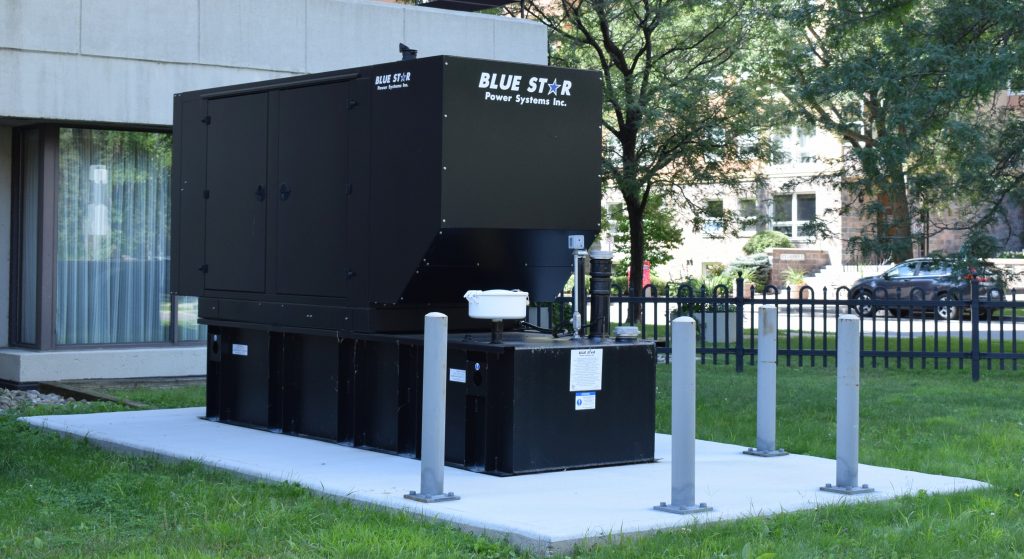
Generator sets have become essential on many construction sites: backup power, relief during outages, support for temporary installations. Yet many teams only monitor them remotely, without real-time alerts. Result: a breakdown discovered too late, an improvised intervention, and delays that accumulate.
In this article, we examine the concrete risks of absent monitoring, the hidden costs they generate, and how to establish simple, reliable monitoring tailored to your needs.
A silent generator set is not necessarily a healthy one
On a construction site, a generator set may appear to be running normally until the moment it will not start. A weak battery, an insufficient fuel level, an overload, a cooling fault: these are all weak signals that often go unnoticed between two site visits.
The problem is not only technical, it is also organizational. When an alert does not arrive at the right moment, teams react in an emergency, schedules get shifted, and the workforce mobilized for the breakdown is no longer available for planned tasks.
The hidden costs of absent monitoring
A generator set failure can have cascading consequences across the entire construction site:
- Response delays: teams can no longer work normally, which delays the next steps of the schedule.
- Unplanned mobilization: a technician must be dispatched on site, sometimes as an urgent call, with the logistical costs that implies.
- Accelerated wear: poorly monitored equipment can run under bad conditions, which reduces its lifespan.
- Operational risk: a power cut can interrupt sensitive activities, in particular when installations depend on a stable power source.
These situations are not rare, but they often stay invisible as long as no indicator makes it possible to anticipate them. The difficulty is not to notice the failure: it is to foresee it early enough to act before it blocks the site.
Anticipate rather than react: the signals to monitor
Effective monitoring relies on a few simple but essential indicators:
- Battery state: an insufficient voltage can prevent starting at the critical moment.
- Fuel level: a low tank can cause an abrupt stop in the middle of an operation.
- Operating hours: tracking usage time makes it possible to plan maintenance at the right moment.
- General equipment condition: temperature, pressure, vibration and other parameters can reveal an emerging anomaly.
The goal is not to multiply sensors without a strategy. It is a matter of choosing the right signals, the ones that provide usable information to decide quickly and avoid costly interruptions.
A telemanagement platform proven on compactors, which we can adapt to your needs
IOTINNOV has developed a telemanagement platform proven on compactors, which we can adapt and extend to your needs. The principle stays the same: surface the essential information, detect abnormal situations, and alert the right people at the right moment.
For your generator sets, this can mean centralized visibility on the state of your fleet, targeted alerts when a critical threshold is reached, and an exploitable history to track the evolution over time. The approach is progressive: you start with the priority indicators, then the setup is enriched based on field feedback and real usage.
The value is keeping a simple, operational readout. Teams do not need a complex system: they need to know quickly whether everything is fine, and what to do if it is not.
How to structure useful monitoring without unnecessary complexity
The success of a telemanagement project depends not only on the technology. It depends above all on the way alerts are configured and on the clarity of responsibilities.
- Define the thresholds: from which fuel level, voltage or temperature should an alert be triggered?
- Identify the recipients: who receives the alert, and when must they intervene?
- Anticipate edge cases: what happens in case of a network outage, a low battery, or a loss of connection?
- Measure effectiveness: are the alerts relevant? Do interventions arrive early enough?
This method avoids two frequent pitfalls: monitoring that is too light to protect anything, and monitoring that is too heavy and drowns teams in false alerts.
The right level of vigilance for your equipment
Every construction site has its own constraints: duration of the works, criticality of the equipment, frequency of interventions, access conditions. Good monitoring must account for this context rather than impose a single model.
The telemanagement platform proven on compactors can be extended to address these varied situations. The idea is to start from your operational priorities, then build a follow-up that brings value from the first weeks, without waiting for a long and complex project.
Conclusion
An unmonitored generator set is a silent risk for the smooth running of a construction site. Breakdowns, delays and emergency interventions are costly, not only in repair, but also in lost time and disrupted organization.
The good news is that targeted monitoring makes it possible to anticipate a large part of these situations. By relying on a telemanagement platform proven on compactors, which we can adapt to your needs, it becomes possible to monitor the state of your equipment remotely, receive relevant alerts, and intervene before the failure blocks the site.
The key is to start simple: identify the most critical equipment, choose a few reliable indicators, and define actionable alerts. It is this progressive approach that turns monitoring into a real lever of operational performance.
Also read
- How IoT transforms industrial maintenance — sensors, protocols and architectures
- Edge Computing for industrial IoT: architecture, protocols and deployment strategies
- Industrial traceability with IoT: from raw material to finished product
Un besoin similaire sur votre parc ?
Échangeons 10 minutes — sans engagement
Parlons de votre besoin →