
The manufacturing industry is undergoing a silent yet profound transformation. The collaborative industrial robot — or cobot — is emerging as a pragmatic solution for SMEs and large corporations looking to automate production without the constraints of traditional industrial robots. Unlike their predecessors confined to safety cages, cobots work hand in hand with human operators. This article explores five concrete applications of the collaborative industrial robot that are already reshaping the production landscape.
1. Precision Assembly and Screwing
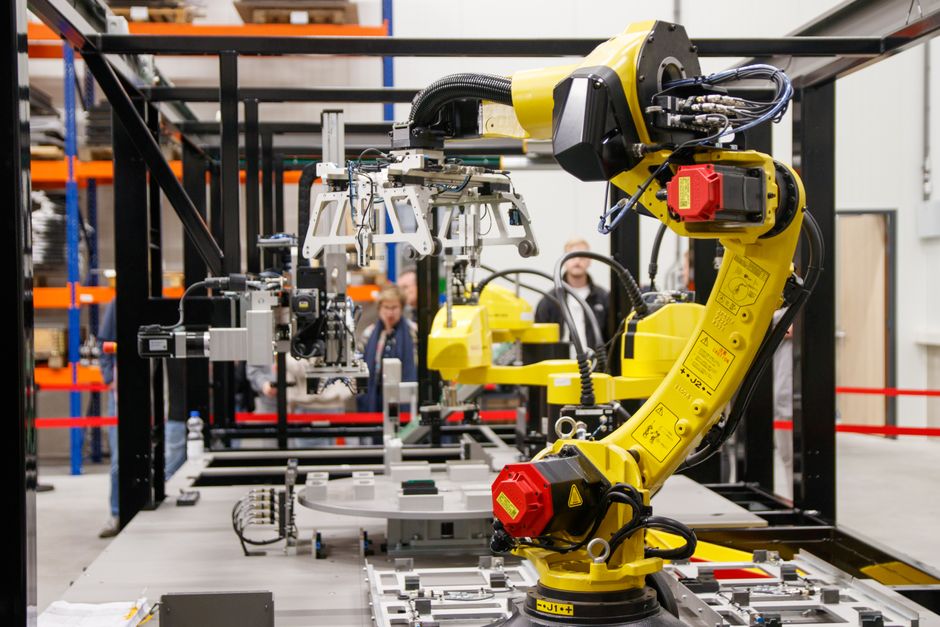
Component assembly is one of the most repetitive tasks in industrial settings. Cobots equipped with torque sensors and machine vision perform screwing operations with a precision that few human operators can maintain over a full day. A collaborative industrial robot can screw hundreds of parts per hour with an error rate below 0.1%, while stopping immediately if an operator enters its workspace.
This application is particularly relevant in the automotive, electronics, and aerospace sectors, where repeatability is essential to final product quality.
2. Quality Control with Machine Vision
Visual quality control is an area where the human eye quickly reaches its limits, especially at high cadences. Cobots equipped with high-resolution cameras and deep learning algorithms inspect each part on the fly: surface defects, dimensional tolerances, missing markings.
The cobot’s strength in this context is not only its precision but also its flexibility. The same robotic arm can switch from an inspection task to an assembly task in minutes, without any hardware modification. This versatility significantly reduces the return on investment.

3. Palletizing and End-of-Line Handling
Palletizing is traditionally a physically demanding task that causes musculoskeletal disorders among operators. Palletizing cobots, with payload capacities ranging from 5 to 30 kg, handle this task without requiring major civil engineering work.
Unlike a conventional industrial palletizer, the cobot can be moved from one line to another in under an hour. For an SME manufacturing several product ranges, this agility is a decisive competitive advantage.
4. Collaborative Welding for Small Batches
Robotic welding existed long before cobots, but it was reserved for large production runs due to programming time and installation costs. With welding cobots, a skilled operator can program a new weld point in seconds using lead-through programming.
This approach makes automated welding accessible to workshops working with small and medium batch sizes. The productivity gain is immediate: where a human welder produces 3 to 5 meters of weld per hour, a cobot can achieve 10 to 15 meters with consistent quality.
5. Machine Tool Loading and Unloading
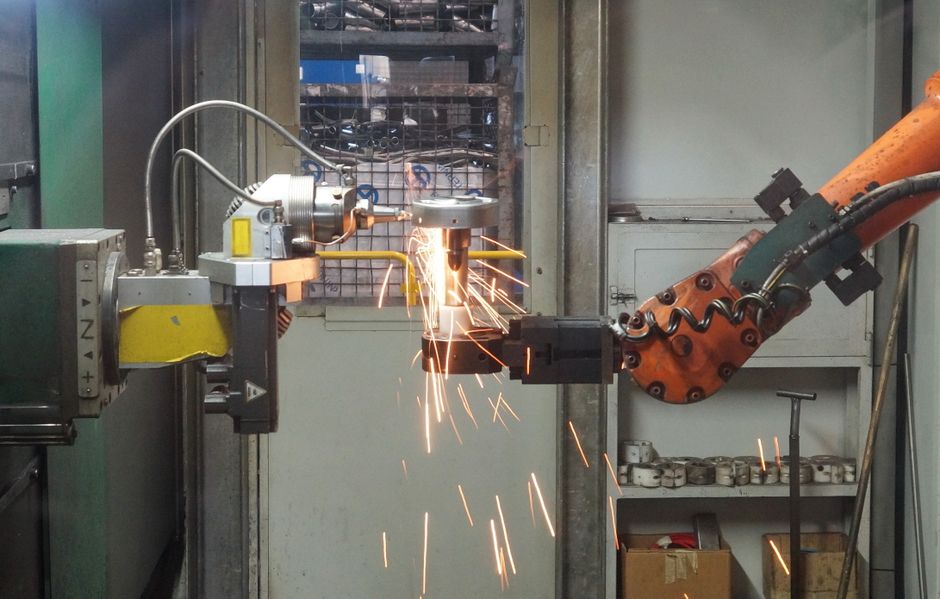
Machine tending — the operation of feeding and emptying a machine tool — is one of the most time-consuming tasks in a machining workshop. An operator spends on average 20 to 30% of their time loading and unloading parts. Cobots take over this task, freeing operators for higher-value-added missions.
A single cobot can serve several machines in rotation, operate 24 hours a day, and requires only a few hours of training to be reprogrammed for a new part.
Why Adopt a Collaborative Industrial Robot Now?
The benefits of cobots go beyond productivity. Their adoption offers several strategic advantages for industrial companies:
- Fast return on investment: between 6 and 18 months depending on the application
- Flexibility: the same cobot can perform several different tasks in the same day
- Safety: built-in sensors allow operation without a cage, reducing the footprint
- Easy programming: no robotics engineer required — operators themselves program the cobot through lead-through guidance
- Improved working conditions: reduction of strenuous and repetitive tasks
The cobotics market is expected to reach $12 billion by 2027, according to industry analyses. Companies investing in this technology now are positioning themselves favorably for the coming decade, as the shortage of skilled labor intensifies in manufacturing.
How to Choose the Right Industrial Cobot?
A few essential criteria to consider before investing in a collaborative industrial robot:
- Payload: evaluate the weight of parts to handle (5 kg, 10 kg, 20 kg are common standards)
- Reach: measure the maximum distance to cover around the cobot
- Environment: some cobots are designed for harsh environments (dust, splashes, high temperatures)
- Integration: check compatibility with your existing equipment (PLC, vision systems, conveyors)
- Software ecosystem: favor open platforms that allow adding features later (vision, sensors, AI)
An industrial sensor manufacturer recently reduced its scrap rate by 40% by integrating a quality control cobot. An SME in machining increased its production capacity by 35% without hiring a single additional operator, by deploying two machine-loading cobots. These concrete examples illustrate why the collaborative industrial robot is no longer a futuristic option, but an accessible and profitable solution today.
Conclusion
Cobotics is not a technology reserved for industry giants. Collaborative robots are now affordable, easy to program, and versatile enough to adapt to a wide variety of applications. According to the International Federation of Robotics, the global cobot market is experiencing double-digit annual growth. Whether for assembly, quality control, palletizing, or machining, the collaborative industrial robot offers a tangible and fast return on investment.
Have you already considered integrating a cobot into your production line? Which application seems most promising for your workshop?
À lire aussi
- AGV and AMR: Autonomous Navigation Architecture for Industry 4.0
- Edge Computing for Industrial IoT: Architecture, Protocols, and Deployment Str
- Machine Vision for Automated Quality Control: Cameras, Embedded AI and Robotic
Un besoin similaire sur votre parc ?
Échangeons 10 minutes — sans engagement
Parlons de votre besoin →